
Sometimes, the Biggest Breakthrough Is a Student Who Tries Again
Preeti Masih never planned to become a teacher. Today, she finds purpose in helping students feel included, build confidence and discover what they are capable of.
A student who once avoided reading aloud begins to participate again. Another, who struggled to connect with classmates, starts looking forward to going to school every day.
For Preeti Masih, an aspiring teacher from Chhattisgarh, these are the moments that make teaching worthwhile. Her journey into teaching was not planned, but it has helped her discover a sense of purpose in helping students feel included, build confidence and recognise their own abilities.
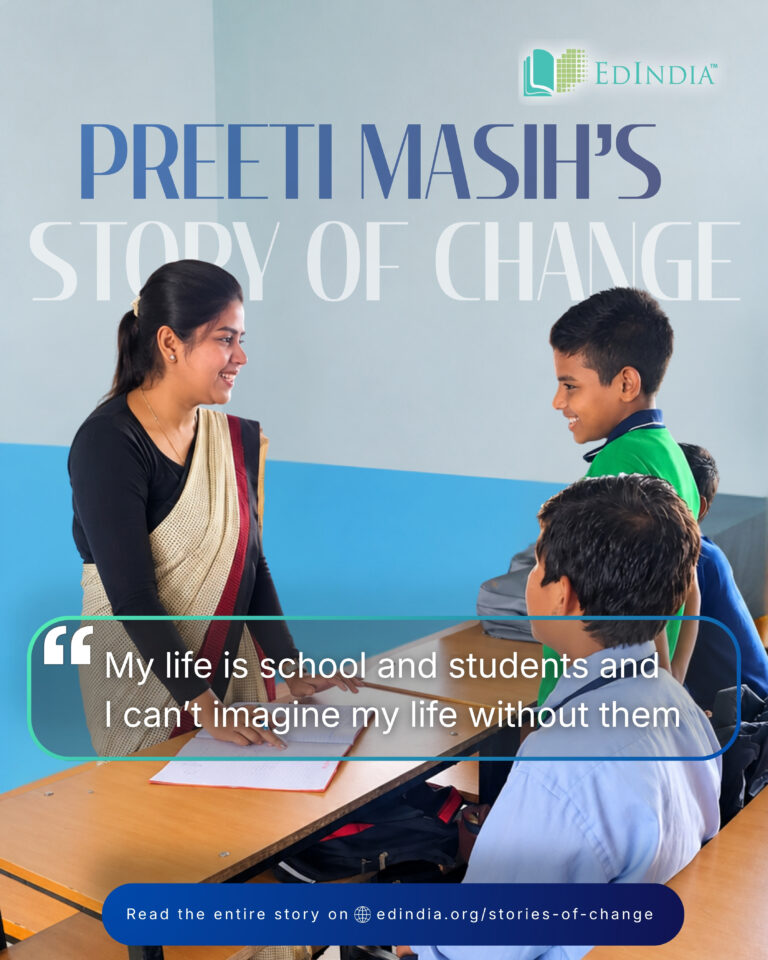
Preeti engaging with students to clear doubts
Her story also highlights why teacher education must go beyond subject knowledge and theoretical training. Teachers need opportunities to develop the skills, confidence and judgement to respond to the diverse needs of students.
She has learnt that teaching is not simply about explaining a concept or completing a syllabus. It is also about noticing who has stopped participating, understanding why a student is struggling and creating the conditions in which they feel confident enough to try again.
It is a lesson she did not expect to learn when she accidentally entered the profession.
The Students Who Changed How She Sees Teaching
One of Preeti’s students used a hearing aid and found it difficult to connect with classmates. As a young teacher with limited experience, Preeti was unsure how best to help. She began communicating through exaggerated hand gestures and often spent lunch with the student when others did not. She encouraged her to participate in classroom activities rather than remain on the sidelines.
Over time, Preeti noticed a positive change in the student’s body language. Her mother later told Preeti that her daughter now looked forward to going to school.
Another student struggled with reading. When classmates laughed at her mistakes, she began withdrawing from classroom participation. Preeti encouraged her to continue reading aloud and not allow others’ reactions to determine what she believed she could achieve.
Neither situation had a ready-made solution. Preeti had to observe, understand and respond.
“If students are making noise, they are fine,” she says. “If they are quiet, I start to intervene.”
For Preeti, silence can be a reason to look closer. She tries not to judge a student’s behaviour immediately, but to understand what might lie behind it.

Preeti Masih with her students
These experiences have taught her that students do not all need the same thing. Some need a different explanation; others need time, encouragement or the reassurance that making a mistake is part of learning.
The change she hopes to see is not always dramatic. Sometimes, it is simply a student willing to participate again.
A Career She Never Planned
Preeti’s journey into teaching began almost by chance. She wanted to become a fashion designer, while her father hoped she would pursue engineering or nursing. He had even paid an advance for an engineering seat.
Preeti refused.
“If not fashion studies, then I will do nothing!” she told him.
She knew what she did not want but had yet to discover what she wanted for herself. After completing her BA and a Diploma in Computer Applications, she attended an interview for a teaching position and was selected.
At first, she thought teaching meant opening a textbook and explaining a lesson. The classroom quickly challenged that assumption. Lesson plans, daily diaries, activities and students with different learning needs demanded preparation, patience and the ability to adapt.
With guidance from senior teachers, she gradually found her footing. Within two years, she had decided to continue in education and enrolled in a Bachelor of Education (B.Ed.) programme.
Her own experience as a learner also shaped her approach. She remembers fondly that Mathematics had been difficult for her, but the warmth and affection of her tuition teacher made the subject less intimidating. She remembers how the way a teacher treats a student can influence how that student feels about learning.
That understanding stayed with her. She began to see that good teaching involves more than knowing a subject. It requires understanding the learner.
Learning to Think Beyond the Lesson Plan
Moving from teaching theory to making it work in a classroom is a significant step for any aspiring teacher. Preeti’s experiences made this distinction tangible: knowing that students need encouragement is one thing; recognising when a student needs it and deciding how to respond is another.
Through Sterlite EdIndia Foundation’s Teacher Education Programme, Preeti participated in Learning Circles, workshops, internship support and mentoring, alongside other programme activities. These opportunities complemented her formal teacher education and helped her engage with the practical demands of the profession.
Learning Circles offered space to discuss teaching and learning, exchange experiences and consider different responses to classroom challenges. Workshops strengthened her engagement with pedagogy, while virtual sessions and on-ground mentoring connected teacher preparation with the realities of classroom practice.
For Preeti, these experiences were relevant to the questions she encountered as a teacher: How do you make a lesson meaningful? How do you encourage a student who has lost confidence? How do you recognise when an explanation is not working?
These are questions that require a thinking teacher, one who can reflect on what is happening in the classroom instead of relying on a fixed set of instructions.
EdIndia’s Teacher Education Programme, initiated in 2019 and aligned with the National Education Policy (NEP) 2020 and the National Professional Standards for Teachers (NPST), supports this development through pedagogical training, practical resources and continued professional learning.
The emphasis is on helping aspiring teachers connect what they know with what they do. For Preeti, the experiences of her students offer a daily reminder of why this connection matters.
Learning That Goes Beyond Training
Preeti also participated in EdIndia’s digital learning activities through the Akrava app, which brings together self-paced courses, interactive quizzes, downloadable worksheets, classroom resources and mock examinations for the Central Teacher Eligibility Test (CTET) and State Teacher Eligibility Tests (STET).
The self-paced courses and instructional resources in Hindi and English gave her access to learning material beyond scheduled sessions. Quizzes offered opportunities to check her understanding, while mock examinations helped her practise for teacher eligibility tests and identify areas for further preparation.
The app is part of a wider set of NPST-aligned resources offered by EdIndia, including printable worksheets and instructional videos. These resources allow aspiring teachers to revisit concepts, strengthen their understanding and continue learning at their own pace.
For Preeti, this learning ecosystem complemented her classroom experience. Preparing to teach involves more than understanding a concept; it means thinking about how to explain it, which activities might help students engage with it and how to assess whether they have understood.
EdIndia also conducts Question Making Competitions in four states, encouraging aspiring teachers to frame questions that reveal how students think. Using Bloom’s Taxonomy, the competitions move beyond questions that test recall towards those that ask students to explain, apply knowledge, analyse and reason.
This distinction matters. A student may remember an answer without understanding the idea behind it. A thoughtfully framed question can help a teacher identify where learning has broken down and what support might help.
For a teacher like Preeti, who has seen students withdraw when they struggle, the ability to assess understanding thoughtfully is an important part of responding to different learning needs.
Together, these opportunities support a more reflective approach to teaching: one in which teachers continue to learn, question their assumptions and adapt their practice.
The Confidence to Trust Her Own Ideas
In 2026, Preeti participated in a Teaching Plan Competition that brought together more than 100 pre-service teachers from 20 colleges in Chhattisgarh.

Preeti won the Teaching Plan Competition 2026 from Columbia College, Raipur, Chhattisgarh
She was nervous. Several participants were using AI tools, and she wondered how her work would compare. She chose to rely largely on her own thinking, using AI only for limited references. Her lesson plan centred on practical teaching aids and activities that would allow students to experience the lesson rather than simply listen to an explanation.
She won.
The medal and trophy were a proud moment, but the experience offered something more lasting: confidence in her own ideas and her ability to turn them into a meaningful learning experience.

Preeti Masih’s coverage in local newspaper for winning the Teaching Plan Competition
For someone who had once been uncertain about her future, the achievement was significant. She could develop an idea, plan with purpose and trust her judgement.
The competition also brought her focus back to what she values in teaching: creating opportunities for students to participate actively in their own learning.
A Purpose She Found Along the Way
Preeti is now considering pursuing a PhD in Education. The young woman who once insisted that fashion design was the only career she wanted has found a profession she cannot imagine leaving behind.
“My life is school and students and I can’t imagine my life without them,” she says.

Her journey has changed the way she understands success. It is not only about completing a qualification or winning a competition. It is also about the student who begins to participate, the learner who finds the courage to read aloud and the individual who feels included in a classroom.
Her own growth has depended on learning from experience and making use of opportunities to strengthen her skills. Through EdIndia’s Teacher Education Programme, she has engaged with professional learning, practical resources and activities that support her development as an aspiring teacher.
But the purpose she has found is visible in the everyday choices she makes: to notice, to ask, to encourage and to try a different approach when a student needs one.
Preeti once believed her future depended on finding the right career. Today, she is discovering that a meaningful career can also take shape through the people we learn to serve.
For her, the measure of a good day may be a lesson completed. It may also be a student who raises a hand after weeks of silence, or one who tries reading aloud despite having been laughed at before.
Those moments may seem small. To the student experiencing them, they can mark the beginning of something bigger.
And for Preeti, they are reason enough to keep learning how to teach.
Learn more about EdIndia program, an exceptional teacher education and training initiative designed for both pre-service and in-service educators.