
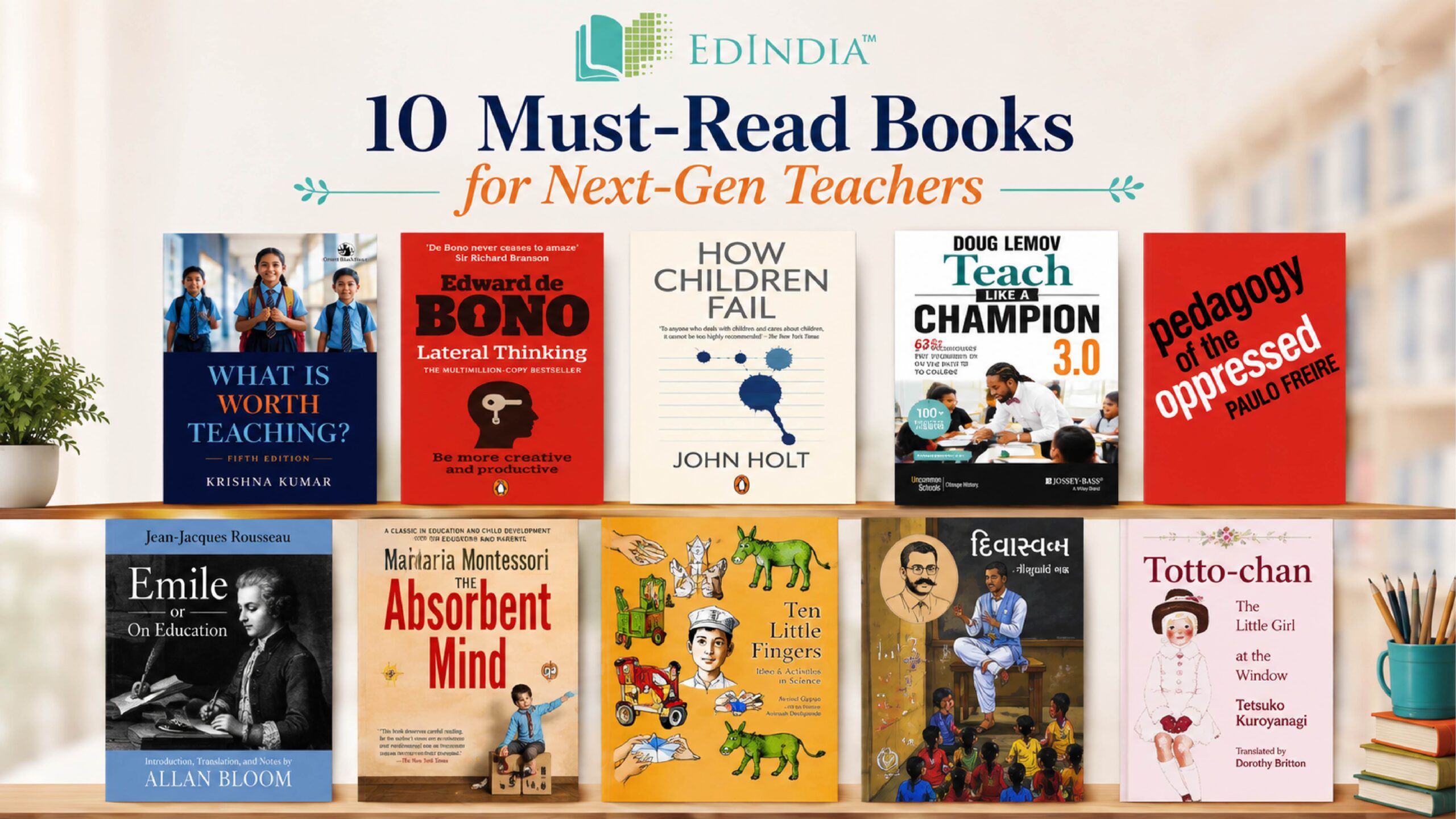

1. Divaswapna - Gijubhai Badheka
Written in 1932, and still the most honest account of an Indian classroom you will read. It follows a teacher who takes charge of a noisy, uninterested Class 4 and slowly wins them over, not with punishment, but with stories, questions and a lot of patience. He tries things. Many of them fail. He writes those down too. Nearly a century later, the problems he describes, crowded rooms, bored children, sceptical seniors, an inspector at the door, feel uncomfortably current.
Best for: Any teacher in India who wants to see real classroom change happen step by step, not in theory.
Written in 1932, and still the most honest account of an Indian classroom you will read. It follows a teacher who takes charge of a noisy, uninterested Class 4 and slowly wins them over, not with punishment, but with stories, questions and a lot of patience. He tries things. Many of them fail. He writes those down too. Nearly a century later, the problems he describes, crowded rooms, bored children, sceptical seniors, an inspector at the door, feel uncomfortably current.
Best for: Any teacher in India who wants to see real classroom change happen step by step, not in theory.

2. What Is Worth Teaching? by Krishna Kumar
Krishna Kumar asks the question most of us are too busy to ask: why are we teaching what we're teaching? He looks at how the Indian syllabus took its present shape, how the textbook quietly became the entire curriculum, and what gets pushed out when exams decide everything. It's a slim book, but it rearranges how you see your own subject.
Best for: Teachers and teacher educators who want to think about curriculum, not just delivery.
Krishna Kumar asks the question most of us are too busy to ask: why are we teaching what we're teaching? He looks at how the Indian syllabus took its present shape, how the textbook quietly became the entire curriculum, and what gets pushed out when exams decide everything. It's a slim book, but it rearranges how you see your own subject.
Best for: Teachers and teacher educators who want to think about curriculum, not just delivery.

3. Ten Little Fingers (Meri Das Ungliyan) - Arvind Gupta
Arvind Gupta spent a lifetime proving you don't need a laboratory to teach science, you need a straw, a rubber band and ten fingers. This book is a collection of simple activities and toys built from things people throw away, each one explained clearly enough for a child to follow. And here's the part most teachers don't know: Gupta puts his books online for free, without copyright restrictions, so you can download it this evening and use it tomorrow morning.
Best for: Primary and science teachers working with small budgets and curious children.
Arvind Gupta spent a lifetime proving you don't need a laboratory to teach science, you need a straw, a rubber band and ten fingers. This book is a collection of simple activities and toys built from things people throw away, each one explained clearly enough for a child to follow. And here's the part most teachers don't know: Gupta puts his books online for free, without copyright restrictions, so you can download it this evening and use it tomorrow morning.
Best for: Primary and science teachers working with small budgets and curious children.

4. Totto-chan: The Little Girl at the Window - Tetsuko Kuroyanagi
A true story about a little girl expelled from her first school for being "disruptive", who then lands at Tomoe Gakuen - a school run out of old railway carriages by a headmaster who lets a six-year-old talk to him for four hours without once interrupting. It is warm, funny and completely disarming. Read it when the term has worn you down and you need reminding why you started.
Best for: Every teacher. Genuinely. Also a lovely book to keep in the school library.
A true story about a little girl expelled from her first school for being "disruptive", who then lands at Tomoe Gakuen - a school run out of old railway carriages by a headmaster who lets a six-year-old talk to him for four hours without once interrupting. It is warm, funny and completely disarming. Read it when the term has worn you down and you need reminding why you started.
Best for: Every teacher. Genuinely. Also a lovely book to keep in the school library.

5. The Absorbent Mind - Maria Montessori
Montessori's central idea is that very young children don't just learn - they absorb, effortlessly, from everything around them. Which puts a great deal of responsibility on what we place in front of them. The book explains why the first six years carry so much weight, and why a thoughtfully prepared classroom often teaches more than a thoughtfully prepared lecture.
Best for: Pre-primary and early-years teachers, and anyone setting up a classroom from scratch.
Montessori's central idea is that very young children don't just learn - they absorb, effortlessly, from everything around them. Which puts a great deal of responsibility on what we place in front of them. The book explains why the first six years carry so much weight, and why a thoughtfully prepared classroom often teaches more than a thoughtfully prepared lecture.
Best for: Pre-primary and early-years teachers, and anyone setting up a classroom from scratch.

6. How Children Fail and How Children Learn - John Holt
Holt sat at the back of classrooms for years and watched what children actually did. What he found was that most of them weren't learning - they were learning to look like they were learning. Guessing what the teacher wanted. Hiding confusion. His work is really about unlearning: shedding the fear and the pleasing-the-teacher habits that school accidentally teaches. Uncomfortable reading, in the best possible way.
Best for: Teachers willing to question their own classroom habits, not just their students'.
Holt sat at the back of classrooms for years and watched what children actually did. What he found was that most of them weren't learning - they were learning to look like they were learning. Guessing what the teacher wanted. Hiding confusion. His work is really about unlearning: shedding the fear and the pleasing-the-teacher habits that school accidentally teaches. Uncomfortable reading, in the best possible way.
Best for: Teachers willing to question their own classroom habits, not just their students'.

7. Lateral Thinking - Edward de Bono
De Bono's point is simple: we're trained to dig one hole deeper, when the answer is often to dig somewhere else entirely. What makes this book useful rather than merely motivating is that he turns creative thinking into something you can actually teach - with exercises and steps, not vague advice about "being innovative". Useful for your students, and useful for you the next time a lesson refuses to land.
Best for: Teachers who want to build problem-solving and creativity as a skill, not treat it as a talent.
De Bono's point is simple: we're trained to dig one hole deeper, when the answer is often to dig somewhere else entirely. What makes this book useful rather than merely motivating is that he turns creative thinking into something you can actually teach - with exercises and steps, not vague advice about "being innovative". Useful for your students, and useful for you the next time a lesson refuses to land.
Best for: Teachers who want to build problem-solving and creativity as a skill, not treat it as a talent.

8. Emile, or On Education - Jean-Jacques Rousseau
Written in 1762, this is where a great deal of modern thinking about childhood began. Rousseau's argument was radical then and is still worth arguing about now: a child is not a small adult waiting to be filled up, and learning by doing beats learning by being told. Parts of it have aged badly - his views on girls' education in particular. Read it to understand where ideas like "child-centred learning" actually came from.
Best for: Teacher educators, B.Ed. and ITEP students, and anyone studying the philosophy of education.
Written in 1762, this is where a great deal of modern thinking about childhood began. Rousseau's argument was radical then and is still worth arguing about now: a child is not a small adult waiting to be filled up, and learning by doing beats learning by being told. Parts of it have aged badly - his views on girls' education in particular. Read it to understand where ideas like "child-centred learning" actually came from.
Best for: Teacher educators, B.Ed. and ITEP students, and anyone studying the philosophy of education.

9. Pedagogy of the Oppressed by Paulo Freire
Freire's objection is to what he calls "banking" education: the teacher deposits, the student stores, nobody thinks. He argues instead for teaching as a dialogue, where students help shape what and how they learn. It's the densest book on this list, but the idea at its centre is straightforward, and it has shaped almost every education book written since.
Best for: Educators interested in the bigger "why" behind teaching.
Freire's objection is to what he calls "banking" education: the teacher deposits, the student stores, nobody thinks. He argues instead for teaching as a dialogue, where students help shape what and how they learn. It's the densest book on this list, but the idea at its centre is straightforward, and it has shaped almost every education book written since.
Best for: Educators interested in the bigger "why" behind teaching.

10. Teach Like a Champion 3.0 - Doug Lemov
The one purely practical book here. Lemov watched hundreds of hours of footage of unusually effective teachers and simply wrote down what they did. The result is a set of small, specific techniques - how to give an instruction people actually follow, how to bring a drifting room back, how to check whether anyone understood. Open it at any page and you'll find something to try tomorrow.
Best for: For teachers who want concrete, ready-to-use classroom techniques.
The one purely practical book here. Lemov watched hundreds of hours of footage of unusually effective teachers and simply wrote down what they did. The result is a set of small, specific techniques - how to give an instruction people actually follow, how to bring a drifting room back, how to check whether anyone understood. Open it at any page and you'll find something to try tomorrow.
Best for: For teachers who want concrete, ready-to-use classroom techniques.