
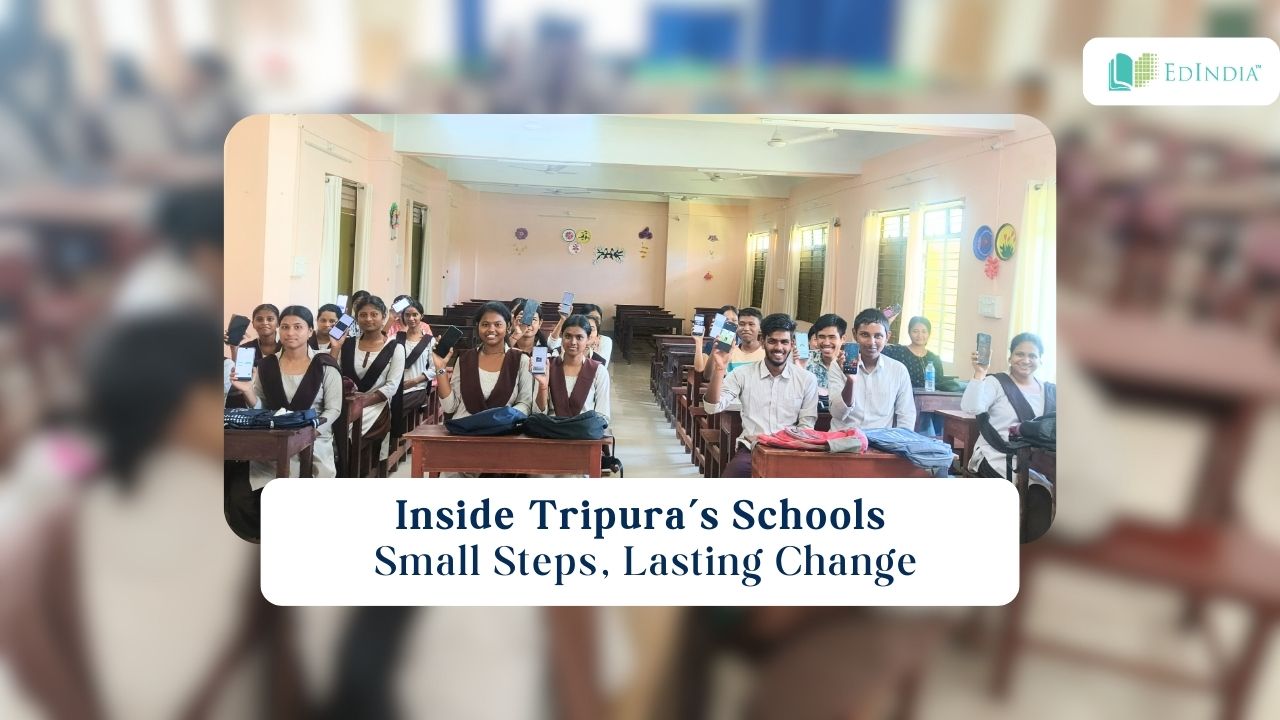
Inside Tripura’s Schools: Small Steps, Lasting Change
Across the country nearly 121 million students are First-generation learners, children whose parents did not have the opportunity to attend school. In many rural and tribal communities, they form a considerable share of the classroom. For these families, education represents unfamiliar ground, yet it is embraced with remarkable hope and determination.
Tripura is a relatively isolated state, and its education system faces several challenges—from limited resources and evolving classroom needs to the growing demand for teaching methods that truly engage today’s learners. Education flourishes when teachers receive sustained support, schools gain access to innovative tools and strong partnerships help make learning more meaningful.
In response to these needs, Sterlite EdIndia Foundation, an Education foundation in India, has been working closely with schools across the state to strengthen the public education system and create classrooms where learning truly comes alive. This progress has not happened overnight. It is the outcome of thoughtful planning, sustained efforts, and close collaboration with the education system to enable meaningful and lasting change.
At the core of the foundation’s work lies the Teacher Education Program, designed to support both pre-service and in-service teachers with modern skills and pedagogical approaches. Rather than relying on one-off training sessions, the program provides continuous workshops, digital resources and mentorship opportunities, ensuring that professional growth is ongoing.
Teacher education in Tripura has gained fresh momentum through collaboration with Samagra Shiksha, the state’s flagship education program, and working closely with SCERT and DIET institutions across the state. By co-creating structured interventions aligned with India’s National Education Policy (NEP) 2020 the Teacher Education Program focuses on strengthening pre-service training and enhancing the quality of classroom practice.
A key effort has been capacity building and skill development. Teacher educators and student teachers have participated in hands-on workshops covering lesson planning, competency-based education, assessment strategies. These sessions are practical rather than theoretical, enabling participants design structured teaching plans and develop reflective teaching habits. The aim is not only to improve subject knowledge, but to nurture confident, well-prepared educators capable of meeting modern classroom needs.
In today’s educational landscape, data serves as a compass guiding policy and practice towards more effective, data-driven education. The foundation’s Data Analytics Support Program helps state and district administrations to make informed, evidence based decisions by turning raw educational data into practical insights. Partnerships with district offices, including the Office of the District Magistrate of South Tripura and Sepahijala Data Systems, enable real-time tracking of key indicators such as enrolment, attendance, learning outcomes and teacher deployment.


Education cannot succeed in isolation. The Community Empowerment Program in Tripura by the foundation was a significant step towards building sustainable school community partnerships. Through the initiative, parents, particularly mothers, were empowered to take an active role in school life, creating a stronger sense of involvement and improving student attendance and well-being. Through consistent engagement, schools evolved into safe, welcoming spaces where families, teachers and students worked together to support student’s learning, building a collective commitment to educating communities together.
Learning became joyful through literacy games and friendly competitions that brought students and parents together, turning reading into a shared family experience. Traditional report cards were replaced with visual formats using colours and symbols, to show progress.
Key initiatives implemented:
- Mother Groups met regularly to monitor attendance and address dropouts
- Mothers supported mid day meals and school cleanliness
- Baal Sabha platforms helped students express ideas and build confidence.
- Community meetings increased local participation in school decisions
- TLM workshops helped teachers use simple, low-cost materials creatively.
- Internship programmes provided mentoring and hands-on classroom experience.
- Orientation sessions guided families on supporting school development.
- Teachers’ Day celebrations, gardening and campus cleaning fostered care and belonging.
- The Question-Making Competition promoted curiosity and concept-based thinking.
- Outreach in regional and tribal languages improved inclusion and access.
This approach strengthened community ownership and ensured that progress continued beyond the program.
In a diverse state like Tripura, where cultures, language and social context shape the learning experience, community ownership proved essential to sustained progress. From its inception until the formal handover in 2024, the community empowerment program worked across 27 government schools to strengthen school–community partnerships and reinforce the public education. Its purpose was to build confidence, strengthen local leadership and create systems that communities could carry forward independently. On completion, the program was formally transitioned to community members and key stakeholders, ensuring continuity without external dependence.
This transformation marks a new chapter in Tripura’s education journey. Classrooms are more inclusive, communities more engaged, students more confident in their learning. The Foundation’s work may have concluded, but its impact lives on, embedded in stronger systems, empowered educators and a sustained commitment to quality education across the state.
As Mr. Alakesh Das, Faculty at DIET Kailashahar, shares, “When student teachers receive continuous feedback during internships, they are better prepared to translate theory into meaningful classroom practice”.
To hear directly from educators in Tripura, watch the full testimonial here.