
Waste Not, Learn More: Creating TLM from Scrap
What a TLM Competition in Rajasthan Tells Us About Teaching Innovatively
A piece of cardboard. A plastic bottle. Some bottle caps.
Most of the time, we throw these items away without a second thought, but for a teacher, they can become something else entirely, tools that explain, engage, and make learning come alive in ways textbooks often cannot.
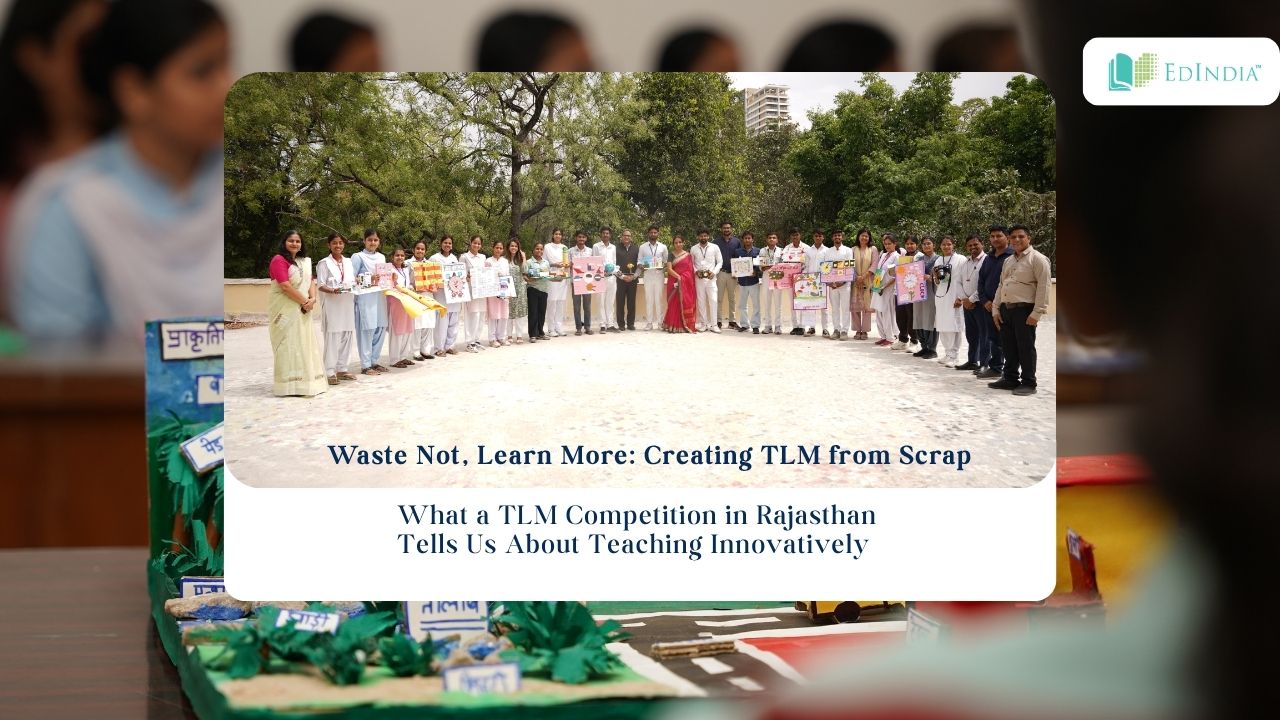
On March 19, 2026, in Udaipur, the State-Level Teaching Learning Material (TLM) Competition brought this transformation to life. The State Council of Educational Research and Training (SCERT), Rajasthan, in collaboration with Sterlite EdIndia Foundation, organised the competition where pre-service teachers from across the state came together, not only to compete, but to demonstrate how they are reimagining classrooms with creativity and purpose; a purposeful event.
Built on the theme of ‘Best out of Waste,’ the competition encouraged participants to design low-cost, effective teaching materials using locally available and reusable resources. It reinforced an important idea: good teaching does not depend on expensive infrastructure, but on how thoughtfully a teacher designs the learning experience.
Out of 697 participants, 22 finalists made it to Udaipur for State Level TLM Competition, but the true magic of this event is not in the numbers, but rather in the stories behind the numbers. Many of the participants journeyed for long distances; some had never left their home towns, and several of the participants had exams the next day, but they chose to attend even if this meant carrying their models with care in order to experience something bigger than just a competition.
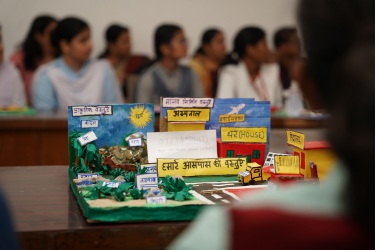
As the competitions began, the venue slowly evolved into an engaging learning space. All tables had unique concepts and clearly defined purposes. For example, there were science models made from recycled materials that explained concepts with clarity, language tools that encouraged interactive learning, and math tools that represented abstract math concepts visually and made it easier for everyone to understand them.
What stood out was not just creativity, but clarity of thought. Participants were demonstrating what they had built and explaining why it mattered. They spoke about real classroom challenges and how their TLMs could help address them. This ability to connect pedagogy with practice is exactly what strong teacher education aims to build. The evaluation process, led by Shri Piyush Kumar Jain, Deputy Director, SCERT Rajasthan and Shrimati Gaytri Swarnkar, Deputy Director, SCERT Rajasthan, reflected this spirit. All participants had ample opportunities to converse regarding their project(s) during the evaluation process, promoting dialogue rather than a uni-directional evaluation process. Participants were also encouraged to elaborate on their method of implementing the project(s), provide feedback and express themselves through either reflective thought and participation. These types of conversations, typically neglected by more formalised settings, will contribute greatly to building confidence in potential teachers.
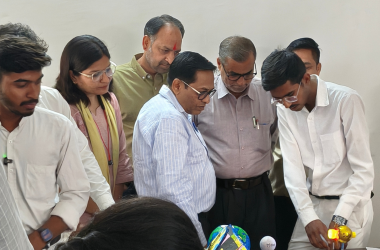
The competition concluded with the announcement of winners. The first position was secured by Baby Prajapati (DIET, Banswara), followed by Dimple (DIET, Sirohi) in second place and Dipika Kanwar (DIET, Udaipur) in third. Beyond these recognitions, all participants gained valuable exposure, learning, and confidence through the experience.
At Sterlite EdIndia Foundation, this is the type of shift that we want to be supportive of, as an NGO that is working in teacher training to improve the capacity of teachers by providing them with professional development programmes that are based on the actual needs of teachers and students within their classroom environment. We strive to promote practices around building a more practical experiences and data driven educational system in India through our Teacher Education Program, Data Analytics Support Program, and Institutional Strengthening Program.
Platforms like TLM competition play a vital role in vital role in a teacher’s learning journey. Whether it is through developing a teaching plan, preparing for mock CTET exam, or creating hands-on learning materials, these experiences help teachers move from theory to practice in meaningful ways.
What the Udaipur event demonstrated was a gradual shift occurring in education: moving away from rote learning, moving away from providing instruction, and focusing on how to engage students and help them understand concepts. At the centre of this shift are teachers who are willing to think differently, adapt their approach, and create meaningful learning experiences for their students.
As the day came to an end, participants packed their models with care. What they carried back, however, was more than just material; it was confidence, exposure, and a stronger sense of purpose.
Because sometimes, the most meaningful changes in education does not come from large reforms or policies. They begin in small, thoughtful moments, when a teacher looks at something ordinary and chooses to turn it into a learning experience.
And that is exactly what Udaipur witnessed.