

Why Teachers are Struggling and How Sterlite EdIndia Foundation is Working for Change
A teacher’s work does not stop with the school bell. After the classroom empties, there are lessons to rethink, records to complete, and constant decisions to make about how to support students who learn at very different levels. Alongside teaching, teachers are also expected to manage administrative responsibilities and demonstrate progress, often with limited guidance on how to balance it all.
In discussions about education quality, the focus frequently turns to teachers as individuals. What often receives less attention is the environment they work in; the training they receive, the academic support available to them, and the systems that shape daily classroom practice.
This is where Sterlite EdIndia Foundation positions its work. The Foundation believes that adequate and good teaching is a function of a robust structure. The Foundation is not focused on providing short-term solutions, but instead on enhancing the underlying structures which train teachers and provide in-classroom assistance and guidance to make academic-based decisions within the public education system.
Sterlite EdIndia Foundation has been working across six states in India and supporting 105+ teacher-training institutions, has trained 18,840+ pre-service teachers, and 913+ Systems Administrators. EdIndia Foundation collaborates with government institutions, to support the implementation of NEP 2020 and NPST aligned development with existing systems.
Currently the Indian education system is going through drastic changes and India’s education landscape reflects the scale of this challenge. In 2024, the CTET pass rate was 16.3%, this indicator points towards gaps in teacher preparation.
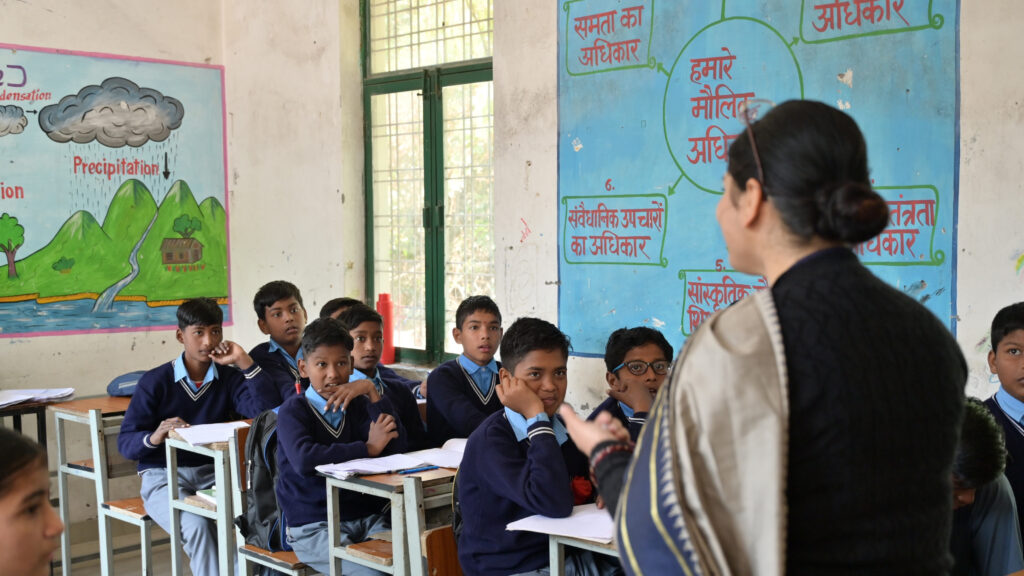

Teacher education initiatives have traditionally relied on theoretical assignments. While the intent behind these programs may be positive, results often fall short, like teaching students about integration of AI in education, use of data, no bag day, happiness programs and emotional wellbeing etc., and changing patterns in traditional subjects, is need of time. Teachers may gain new information, but without continuous support, follow-ups, and alignment with institutional practices, it becomes difficult to apply this learning consistently in classrooms.
We address this challenge by designing teacher support as an ongoing academic process. Teachers engage in continuous learning, reflective practice, and contextual pedagogy inputs that are grounded in real classroom realities. This gradual approach helps build confidence and professional agency over time.
The Teacher Education Program plays a critical role in this approach. When pre-service teacher education is strong, student-teachers enter classrooms with clarity about learners, teaching strategies, and professional responsibilities. EdIndia Foundation works closely with DIETs and Teacher Education Institutions to strengthen how the existing curricula are delivered. The focus remains on classroom pedagogy, assessment practices, communication skills, and reflective teaching.
Faculty members are supported to incorporate discussions, classroom simulations, and action research into their teaching practices. This enables student-teachers to connect theory with practice while still in training. Many report feeling more confident during school internships as they better understand real classroom dynamics.
Another important area of support is the use of education data. Teachers and administrators routinely collect data, but it is not always easy to interpret or apply for planning. Through the Data Analytics Support Program (click here to know more), EdIndia Foundation works with administrators and academic leaders to develop simple tools that help systems record, track, and analyse learning data more effectively.
When data-driven academic decisions become easier to make, data transforms from an administrative burden into a meaningful classroom resource. Teachers are better equipped to identify learning gaps, particularly in foundational literacy and numeracy, and adjust teaching strategies accordingly. Streamlined systems also reduce duplication and manual workload.
Strong institutions are essential for effective teaching. Clear academic planning, defined leadership roles, and consistent processes create an environment where teachers can focus on instruction. EdIndia Foundation’s Institutional Strengthening Program (click here to know more) works closely with SCERTs and DIETs to enhance academic planning systems, leadership capacity, and institutional processes.
While systemic change takes time, early shifts are visible. Teacher educators adapt their engagement with student-teachers, administrators use academic data to guide planning discussions, and teachers refine classroom strategies based on clearer insights into student learning.
Supporting teachers requires more than individual effort. It requires strong curricula, continuous training, effective pedagogy, meaningful use of data, and well-functioning institutions. By bridging teacher education, data analytics, and institutional strengthening, Sterlite EdIndia Foundation contributes to education systems that support teachers consistently and sustainably.
Improving teacher quality is not about increasing pressure on teachers. It is about providing the right support, building trust, and strengthening systems. Through work across pre-service education, in-service teacher support, data-driven planning, research, and institutional development, the Foundation ensures that teachers are not expected to fix systemic challenges alone.
Read our blog on AI in Education – (Click here to read)