
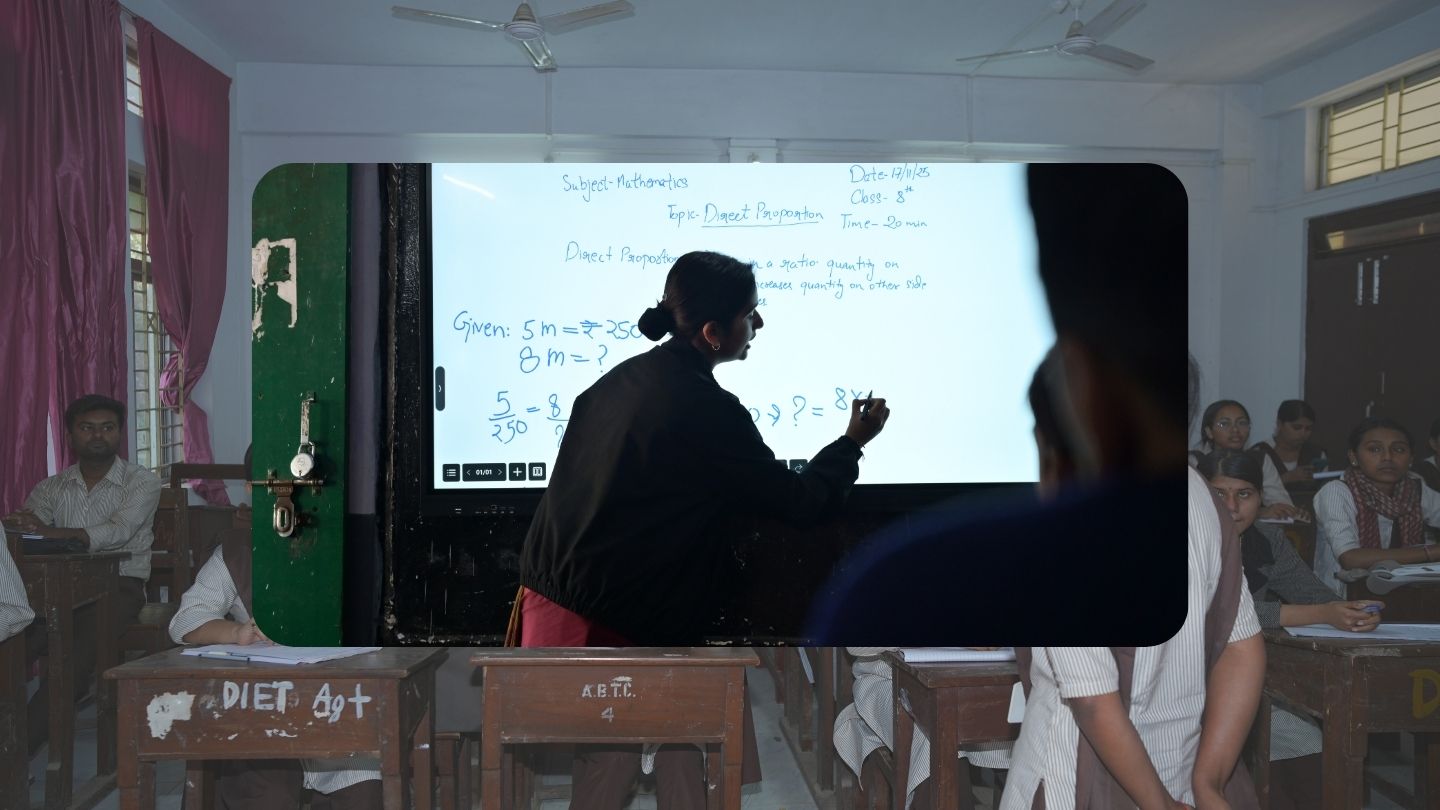
What is DIET? The Story Behind India's District Institutes of Education and Training
How do you improve the quality of education for millions of children?
Build more schools? Introduce better textbooks? Reform examinations?
Or do you start with the people who stand at the front of the classroom every day, and ensure that students are better prepared, better supported, and better equipped to shape young minds?
This was the thinking that shaped the National Policy on Education 1986, one of the most significant milestones in India’s educational history. The policy recognised that meaningful reform would not happen through infrastructure or curriculum changes alone. It would require investing in teachers and creating institutions that could prepare them, support them, and help them grow throughout their careers.
That vision led to the establishment of the DIETs, district-level institutions designed to strengthen teacher education and improve the quality of elementary education in India.
Nearly four decades later, DIETs continue to play a crucial role in India’s education system. They train future teachers, support educators already working in schools, develop academic resources, conduct research, and help bring education reforms to life in classrooms in the country.
Yet, despite their importance, DIETs remain one of the least understood parts of India’s education ecosystem.

A District Institute of Education and Training is a district-level teacher education institution established to strengthen elementary education through high-quality teacher preparation, professional development, academic research, and institutional support.
The first wave of DIETs was introduced under the Centrally Sponsored Scheme following the National Policy on Education 1986, with the aim of creating one such institution in every district. The idea was revolutionary for its time: instead of concentrating teacher education in a handful of universities and colleges, India would decentralise academic support and bring it closer to schools and communities.
In simple terms, a DIET exists to ensure that teachers are not only qualified but also well-equipped to respond to the changing needs of classrooms.
Why Were DIETs Needed?
Before DIETs were established, teacher education in many parts of India was fragmented and often disconnected from the realities of local schools. Training institutions were concentrated in urban centres, and once teachers entered the profession, structured opportunities for continuous learning were limited.
As elementary education expanded in India, policymakers realised that improving access to schools would mean little if teaching quality did not improve alongside it.
DIETs were therefore conceived as district-level academic resource centres, institutions that could prepare aspiring teachers, strengthen practising educators, undertake local research, and provide ongoing support to schools.
The philosophy was simple, better institutions create better teachers, and better teachers create better learning experiences for children.
Where Do DIETs Fit in India’s Education System?
India’s education system is built on collaboration at multiple levels.
At the national level, bodies such as the National Council of Educational Research and Training (NCERT) develop curriculum frameworks and academic guidance. At the state level, State Councils of Educational Research and Training (SCERTs) adapt these frameworks and provide policy direction.
DIETs operate at the district level, acting as the bridge between policy and practice. They work closely with schools, teacher educators, district administrations, and education officials to ensure that educational reforms translate into meaningful improvements in classrooms.
They are, in many ways, the engines that drive teacher development at the grassroots.
What Do DIETs Actually Do?
Although their responsibilities vary from state to state, DIETs perform several key functions that contribute to stronger education systems.
Preparing Future Teachers
Many DIETs offer the Diploma in Elementary Education (D.El.Ed.), preparing aspiring teachers with subject knowledge, pedagogy, classroom management skills, child development concepts, and practical teaching experience.
Supporting Teachers Already in Service
Teaching is not a profession where learning stops after graduation. DIETs organise workshops, orientation programmes, refresher courses, and capacity-building initiatives that help practising teachers stay updated with changing curricula, pedagogies, and classroom needs.
Developing Teaching-Learning Resources
From lesson plans and activity-based materials to assessment tools and locally contextualised resources, DIETs support teachers with materials that make classroom instruction more effective and engaging.
Conducting Educational Research
Many DIETs undertake action research and district-level studies to understand local educational challenges and identify practical solutions that improve teaching and learning.
Supporting Education Systems
DIETs collaborate with SCERTs, Block Resource Centres, Cluster Resource Centres, schools, and district administrations to strengthen curriculum implementation, mentoring, academic planning, and institutional development.


Why DIETs Matter in the Era of NEP 2020
The National Education Policy 2020 has renewed national attention on teacher quality.
Its emphasis on competency-based education, foundational literacy and numeracy, experiential learning, multilingual classrooms, technology integration, and continuous professional development places teachers at the centre of educational transformation.
But ambitious policies alone cannot improve learning outcomes.
They require institutions capable of preparing teachers, mentoring them throughout their careers, and helping them translate policy into classroom practice. DIETs are uniquely positioned to fulfil this role.
As India works to implement NEP 2020, strengthening DIETs will be critical to ensuring that reforms reach every classroom, not just policy documents.
The Challenges Ahead
Many DIET institutions are under strain due to faculty shortages, gaps in their infrastructure and the variable capacity of those institutions to meet institutional needs resulting in limited opportunities to collaborate on academic or research activities. In addition, rapid technological advances and changing pedagogical practices will lead to DIETs being expected to take on additional responsibilities as teacher educator institutions.
To fulfil these expectations will require continuous investment in areas such as physical facilities and infrastructure, as well as the development of faculty, leadership of institutions, digital resources, collaborating with partners and the use of evidence-based planning methodologies.
How Sterlite EdIndia Foundation is Strengthening DIETs
At Sterlite EdIndia Foundation, we believe that meaningful educational change begins long before a teacher enters a classroom. It begins by strengthening the institutions that prepare and support educators.
Through our Institutional Strengthening Programme, we work alongside state governments and SCERTs to strengthen teacher education systems and build institutional capacity within District Institutes of Education and Training.
Today, the programme supports 4 SCERTs, 87 DIETs, and 397 DIET faculty members. Our work focuses on strengthening faculty capabilities, improving institutional processes, integrating technology into academic practice, promoting data-informed decision-making, and supporting sustainable systems that can continue to benefit educators over the long term.
Rather than viewing teacher development as a one-time intervention, our approach is centred on building resilient institutions that continuously nurture teacher educators, aspiring teachers, and education leaders. By strengthening DIETs, we aim to strengthen the entire education ecosystem.
The story of DIETs is, in many ways, the story of India’s belief that teachers matter.
Nearly forty years after they were first envisioned, these institutions remain indispensable to the country’s efforts to improve education quality. They quietly influence thousands of classrooms every day by shaping the people who stand at the front of them.
As India continues its journey towards achieving the goals of NEP 2020 and building a more equitable, inclusive, and future-ready education system, investing in DIETs is not merely about improving teacher education.
It is about investing in every child whose future depends on a well-prepared, confident, and inspired teacher.
Frequently Asked Questions
DIET means District Institute of Education and Training
DIETs were formed in line with India’s National Policy on Education (1986), so as to decentralise Teacher Education and create District Academic Resource Centres for strengthening Elementary Education
DIET functions to prepare teachers (the future Elementary School Teacher), to assist in-service development of teachers, to do Educational Research, to develop Teaching-Learning Resources and to assist schools / Local Education Systems with providing Academic Support.
Most DIET offer a D.EI.Ed. (Diploma in Elementary Education) programme and provide opportunities for professional development for practicing teachers and Teacher Educators.
SCERT operate at the State Level, providing Curriculum and Policy Leadership and Guidance; while DIET operate from District Level, implementing the Teacher Education programme and strengthening Classroom Practices.
NEP 2020 focuses on the Improving of Teacher Quality and the Continuous Professional Development of Teachers; and both DIET prepare Teachers and are there to support them throughout their career.
Through its Institutional Strengthening Programme, Sterlite EdIndia Foundation works with 4 SCERTs, 87 DIETs, and 397 DIET faculty members to strengthen institutional capacity, faculty development, technology integration, and evidence-based academic planning.
Because better teacher education leads to better teaching, stronger classrooms, improved learning outcomes, and ultimately a more resilient and equitable education system for future generations.