
5 tools every school leader should use for data-based planning
Walk into any school or college administration office today and you will find data everywhere: attendance registers, assessment records, feedback forms, enrolment sheets, teacher training records, classroom observations, monthly reports, and digital dashboards. Information is not missing from most education institutions. In fact, schools and colleges are collecting more data than ever before. The real challenge is that while information is continuously being recorded, it is not always used consistently to guide decisions, improve planning, or strengthen implementation.
That is where strong leadership stands apart. Effective education leaders do not see data as a reporting burden; they see it as a tool for improvement. Making good use of already available information and recognising patterns can make decision-making faster, more targeted, and evidence-based. Schools and institutions that actively use data for monitoring, evaluation, and implementation often see quicker turnaround in both decision-making and execution. Instead of relying on assumptions, leaders are able to identify what is working, where gaps exist, and which interventions require immediate attention.
Today, data analytics has advanced significantly, allowing administrators to analyse student performance in far more meaningful ways. Schools can identify which subjects or chapters require additional attention, which groups of students need extra academic support, and which learners are progressing well and may benefit from advanced engagement. Data can be analysed subject-wise, class-wise, assessment-wise, and even through individual learning progress trends over time. This allows institutions to organise focused interventions, remedial classes, mentoring support, and differentiated learning strategies based on actual student needs rather than broad assumptions.
Data-based planning simply means using the evidence already available, to make better decisions earlier and with greater clarity. At a time when schools and colleges are already maintaining large volumes of digital records, this information must be viewed not only as administrative documentation but also as an opportunity to create research-backed case studies, identify successful practices, and build scalable models for improving educational outcomes.
School leaders who want to better understand how attendance trends can be tracked can explore simple resources like this Excel attendance tracking guide, which shows how schools can quickly identify patterns and respond before problems grow bigger.
It does not require expensive technology or complicated systems. It requires the discipline to notice patterns, ask the right questions, and act before small issues become larger ones.
This approach also aligns closely with the priorities of the National Education Policy 2020. Foundational literacy and numeracy, competency-based learning, continuous assessment, teacher development, inclusion, technology integration, and stronger governance all depend on leaders being able to identify needs quickly and respond effectively. Good policy creates direction, but data helps leaders turn that direction into results.
Teachers and school leaders can also explore this simple guide on using data in schools to better understand how data supports school improvement.
The good news is that meaningful change often begins with a few practical tools used consistently.
5 Practical Tools for Data-Based Planning
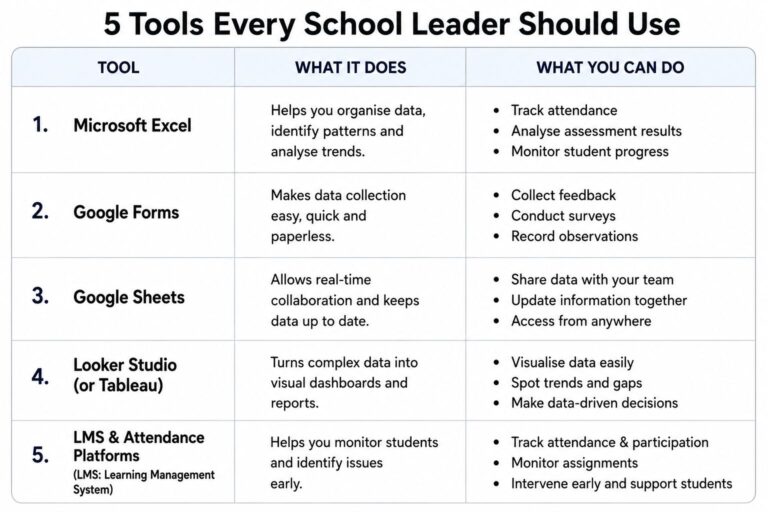
Here are the links to learn these tools:-
- Microsoft Excel – Microsoft Excel Tutorial for Beginners
- Google Forms – Data Collection from Google Form
- Google Sheets – Google Sheets for Beginners
- Lookers Studio – Lookers Studio Course
- LMS & Attendance Platforms – 9 Best free and open source LMS
Of course, tools alone do not solve the problem. Many leaders were never formally trained to use data confidently. Time for analysis feels limited, data quality may be inconsistent, and different systems often do not connect with one another. In some places, data collection has become associated with compliance rather than improvement, so information is submitted because it is required, not because it is meaningfully used.
When decisions depend only on memory, instinct, or delayed reporting, leaders remain busy but not always effective. Energy goes into chasing updates, reconciling files, and responding late. Important issues are overshadowed by urgent ones, and the quality of decisions suffers because leaders are forced to act without a full picture.


How School Leaders Can Start Using Data for Better Decision-Making
School leaders do not need complex systems to begin using data effectively. Small and consistent practices can significantly improve planning and decision-making.
- Focus on a few key indicators: Start by tracking critical areas such as attendance, learning outcomes, assessment performance, teacher participation, or classroom observations.
- Review data regularly: Set aside time every week or month to review trends, identify gaps, and discuss priorities with academic teams.
- Use simple dashboards or trackers: Visual tools like excel, google sheets, or dashboards make patterns easier to identify and decisions faster to make.
- Turn every review into action: Data should lead to clear next steps such as remedial support, mentoring, parent engagement, or resource allocation.
- Build a culture of evidence-based planning: Encourage teams to use data for improvement and problem-solving rather than only for reporting or compliance.
Consistent use of even simple data tools can help school leaders move from reactive management to strategic and informed leadership.
These small shifts, repeated consistently, create stronger systems, smarter decisions, and better outcomes for students.
School leaders already work hard. What many systems need now is not more effort, but more clarity. Data-based planning does not add more work. It helps leaders spend less time chasing numbers, less time reacting late, and more time focusing on what matters most: student learning. The schools that improve most consistently will not always be the ones with the biggest budgets or the newest technology. They will be the ones where leaders learn to notice patterns early, act with confidence, and use evidence with purpose.
And often, that transformation begins when one leader chooses to make the next decision based on evidence, not assumption.